
 Sanj Chandran
We never trusted photos because they were labelled
The EU's AI labelling deadline is 2 December. The label was never what made photos trustworthy. The cost of faking one was.
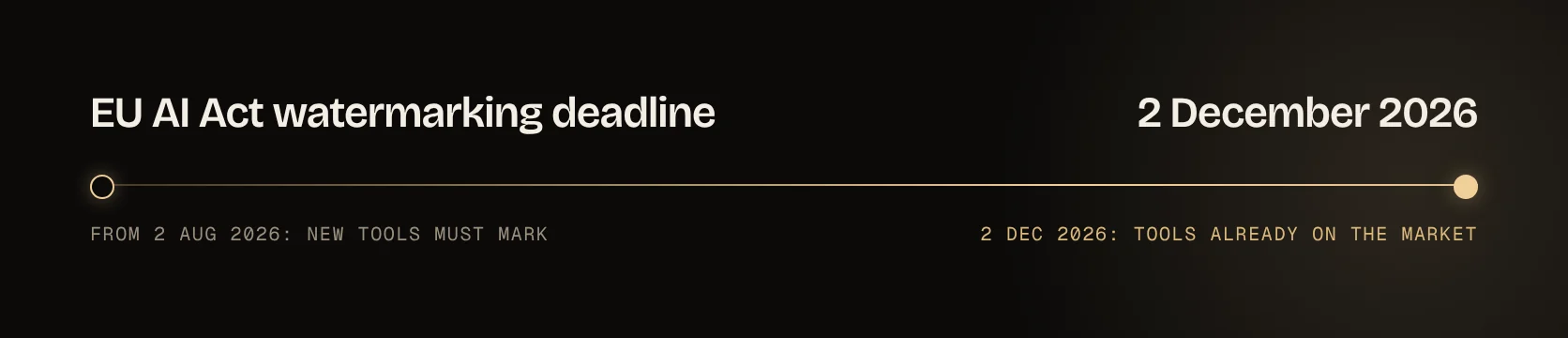
From Wednesday 2 December, every generative AI tool on the EU market has to mark what it makes, so it can be detected as AI-generated. It's the last part of the EU AI Act's transparency rules to apply.
The obvious question is: why now? Nobody labelled photos before. Photoshop has been editing reality since 1990. Digital cameras have long written the make and model into the file, and nobody ever looked. Why does AI suddenly need a label?
It's a fair question. I think the answer is more interesting than the law itself.
The safeguard was never a label. It was cost.
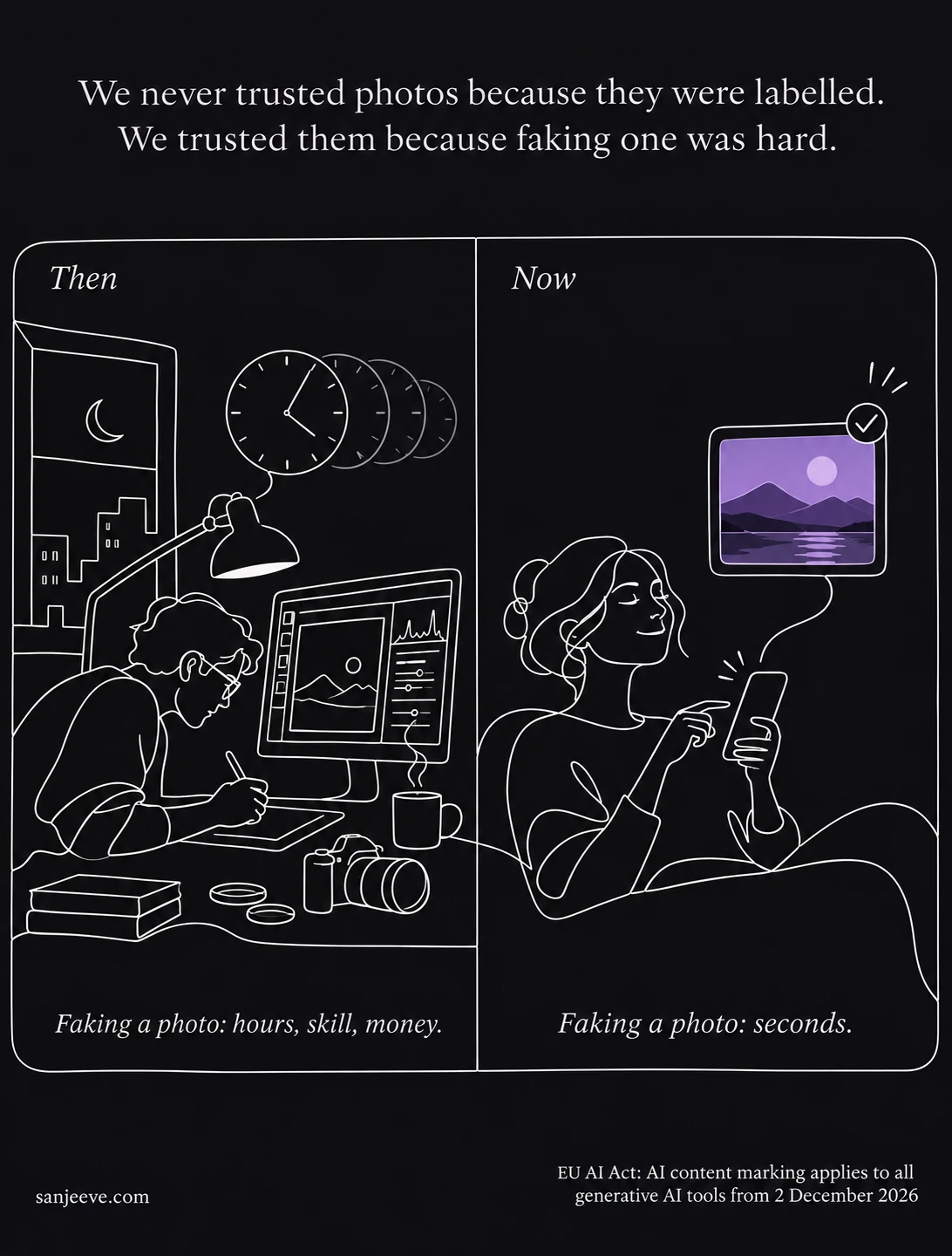
We trusted photos for a simple reason: faking a convincing one was hard. It took skill, software, hours and usually money. Most people couldn't do it, and the ones who could rarely bothered unless the prize was big.
That cost did a job nobody noticed. It meant a photo was a reasonable stand-in for the truth in everyday decisions. A claims handler, a border officer or a pharmacist could look at a picture and move on.
Where editing did cause a specific harm, rules followed, but narrowly. Norway, for example, has required a standard label since July 2022 on adverts where body shape, size or skin has been retouched. That law targets one problem, not editing in general.
AI removed the cost
What's changed isn't that images can be edited. They always could be. It's that a convincing fake, including a fake of a specific real person, now takes seconds and no skill.
Once the cost is gone, the safeguard is gone with it. A photo can no longer prove much on its own, because producing one is no longer evidence of effort.
That's the real reason for the label. It isn't about AI being bad. It's about replacing a safeguard we lost.
What the EU actually requires
The rules are narrower than the headlines suggest:
- The AI companies do the marking. Providers of generative AI must mark images, video, audio and text in a machine-readable way. New tools have had to do this since August. Tools already on the market get until 2 December.
- Ordinary editing is exempt. If the AI is only assisting with standard editing and doesn't substantially change the content, there's no duty to mark.
- Publishers have a narrower duty. If you publish a deepfake, or AI-written text informing the public on matters of public interest, you have to disclose it. For text, there's an exception where a person has reviewed it and takes editorial responsibility.
- The UK has no equivalent general rule. If you publish to both markets, the EU now sets your standard.
In other words, the law already agrees that most edited images don't need a label. It's aimed at synthetic content that could pass as real.
Most images won't care. Some decisions will.
A campaign visual, a slide, a meme. Nobody needs to know how they were made, and nothing goes wrong if the label falls off.
The label matters where a picture is used as proof, especially when a decision is made remotely, by someone who never meets the person:
- Remote prescribing. Earlier this year an ITV News reporter edited her photos to look heavier and was sent weight-loss injections by three online pharmacies. The pharmacy regulator inspected all three.
- Insurance claims. A photo of the damage is often the main evidence.
- Identity. An ID check, or simply a WhatsApp profile picture saying "this is your boss". This week someone used mine to message my own team.
- News. An image of an event that never happened.
These are exactly the places where cost used to do the protecting.
A label alone won't protect the proof cases
The marking is fragile. A screenshot can strip the metadata, and research has shown watermarks can be removed or even faked. So in the places that matter, "check for the label" isn't enough. Anyone trying to cheat will simply remove it.
The better question for those cases is not "was this made by AI?" but "can this show where it came from?" That points to proving origin at the moment of capture, not detecting fakes afterwards. Some phones already do this: Google's Pixel 10 attaches signed Content Credentials to every photo its camera takes.
For anyone whose business runs on photos as evidence, that's the shift to plan for. Don't just look for the AI label. Design how the photo gets to you in the first place.
The question to ask
Wednesday's deadline will make AI labels common. Most of the time, nobody will care, and that's fine.
So the useful question isn't whether your images are labelled. It's this: where in your business does a photo still count as proof?
Sources
- EU AI Act, Article 50: Transparency obligations for providers and deployers of certain AI systems
- Cuatrecasas: Digital Omnibus on AI published in the Official Journal, 24 July 2026
- Goodwin: EU AI Act transparency obligations now in force, August 2026
- Norwegian Consumer Authority: Guideline on labelling retouched advertising
- ITV News via STV: People with healthy BMI using AI to get weight-loss jabs
- Amateur Photographer: Alarm over use of photo editing software to obtain weight loss jabs (includes the GPhC response)
- Google: How Pixel and Android are bringing a new level of trust to your images with C2PA Content Credentials
- Saberi et al., Robustness of AI-image detectors: fundamental limits and practical attacks, ICLR 2024