
 Sanj Chandran
Where does explaining stop?
Explaining and diagnosing are not the same thing, but try saying exactly where one stops. Apple's new health AI study makes it a live question.
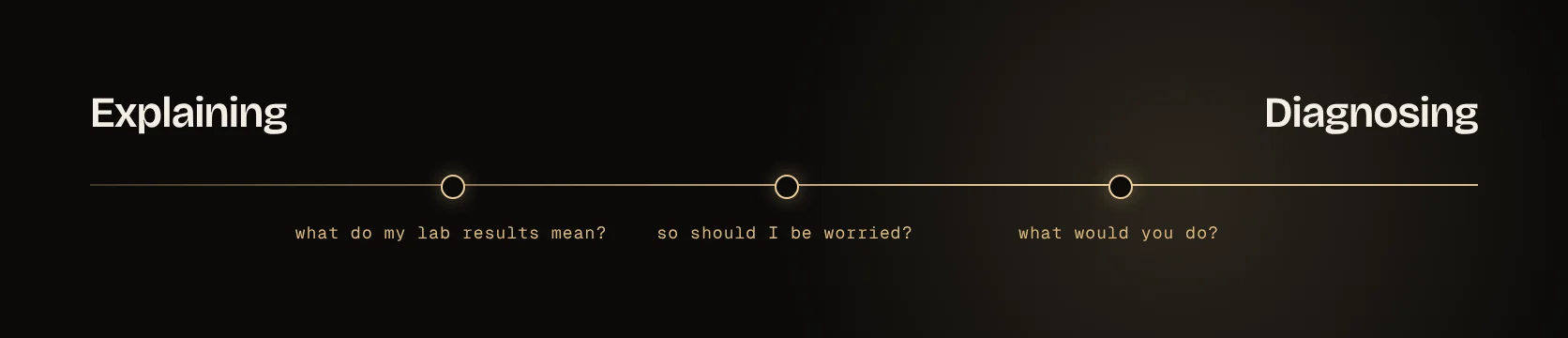
Here's something I keep coming back to. Explaining and diagnosing are not the same thing, but try saying exactly where one stops. It's harder than it sounds.
Think about how people actually ask a health AI:
- "What do my lab results mean?"
- "So should I be worried?"
- "What would you do?"
Which one of those is diagnosing? Have a think, because I'll ask you again at the end.
Explaining versus diagnosing
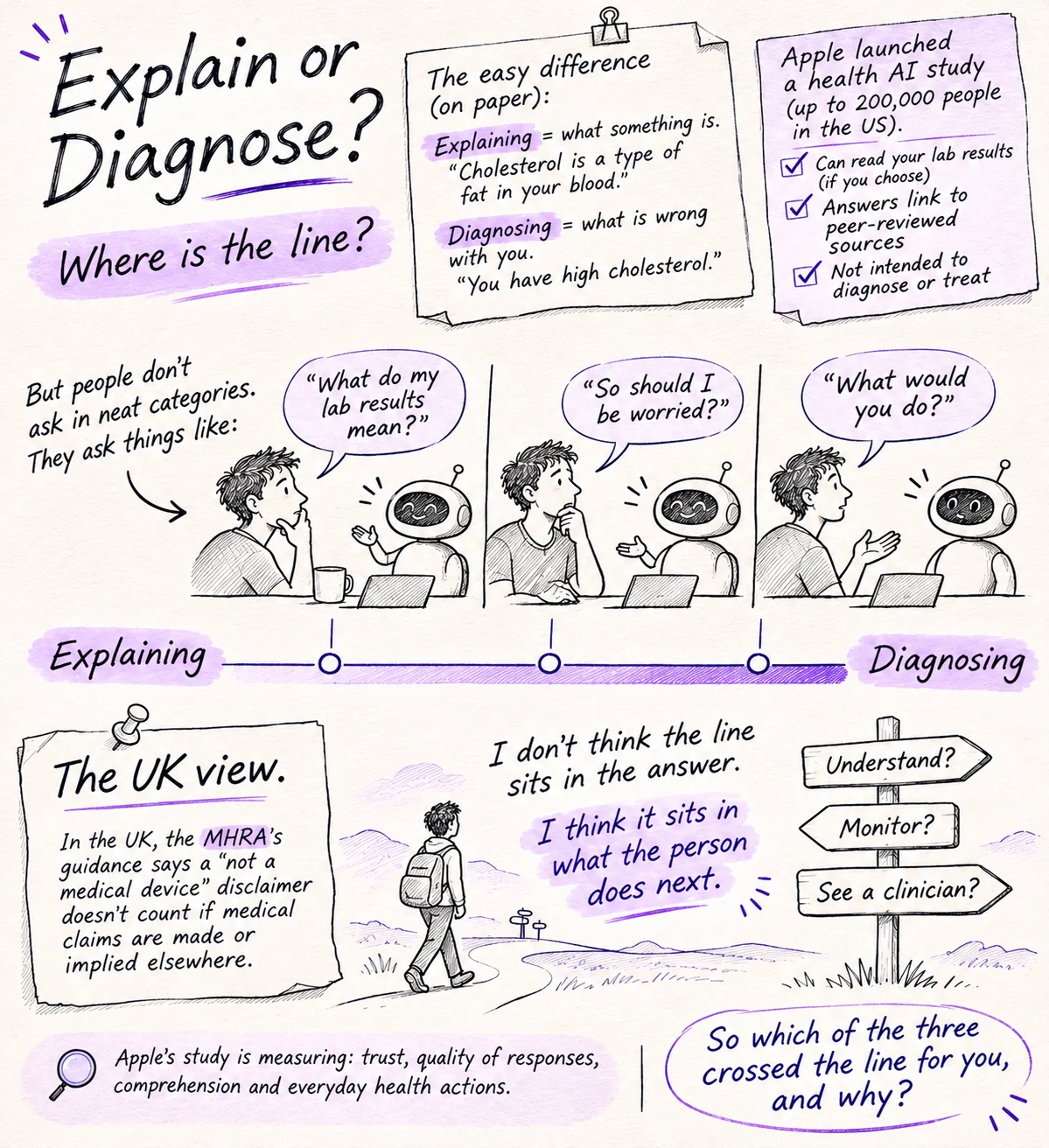
Let me keep it simple. Explaining tells you what something is. "Cholesterol is a type of fat in your blood."
Diagnosing tells you what's wrong with you. "You have high cholesterol."
That's easy on paper. It gets messy the moment a real person asks. "What do my lab results mean?" sounds like a request for an explanation, but the answer is about their own results, not about cholesterol in general. And by "So should I be worried?", I don't think they're asking what something is anymore. They're asking what it means for them.
So what did Apple just do?
On 15 November, Apple announced a research study called the Apple Health AI Usage Study. It's open to up to 200,000 people aged 21 and over in the US, so UK readers can't join.
If you choose to, you can share your health data with it, including lab results. Its answers link to peer-reviewed clinical sources. Apple says the app isn't meant to diagnose or treat any condition, and it has guardrails that are meant to spot certain worrying questions and point you to a provider or other help. Note the word meant. It's an intention, not a guarantee.
The study itself is looking at what drives trust, how good the answers are, whether people understand them, and what they actually do about their health afterwards.
What about the UK?
Apple's study is US only, so UK rules don't apply to it. But I find the UK view really helpful for thinking about this.
The MHRA's guidance for apps and software says what makes something a medical device is its intended purpose, and that comes from how it's labelled, described and promoted. So a general "not a medical device" line doesn't help if you're making or implying medical claims somewhere else. Saying "for information only" doesn't reduce your obligations either.
Different country, same question really: what a tool says versus what it does. The guidance does get updated, so check gov.uk for the latest wording.
What real people do with it
There's a study that tested exactly this. It was published in Nature Medicine in February 2026, led by Bean and colleagues. They gave 1,298 UK adults medical scenarios written by doctors and asked them to work out the condition and what to do next. Some used an AI chatbot (GPT-4o, Llama 3 or Command R+) and some didn't.
The AI on its own did well. It named a relevant condition in 94.9% of cases and the right next step in 56.3%.
The people using it did worse. They identified a relevant condition in fewer than 34.5% of cases, and the right next step in fewer than 44.2%. People without a chatbot actually had 1.76 times the odds of identifying a condition, and there was no significant difference between the groups on the next step.
One caveat: it tested GPT-4o, Llama 3 and Command R+, so newer models may behave differently.
What I take from it is that a good answer and a good outcome are not the same thing. A disclaimer can't tell you that. Only watching what people actually do can.
Where I'd draw the line
This is just my view, not a finding. I don't think the line sits in the answer. I think it sits in what the person does next.
The same sentence from an AI can mean "good to know" to one person and "I'm fine, I'll skip the doctor" to another. If an answer changes what someone does about their health, then for that person it has acted like a diagnosis, whatever the label says.
That's why Apple's study interests me. It isn't only checking whether the answers are right. It's looking at trust, understanding and what people do afterwards, and that's where I think the line really is.
I work with clinics, so I see this from the other side. People tend to act on what's on the screen, not on the small print.
Over to you
So which of the three crossed the line for you, and why? I'd really like to hear where you'd draw it, especially if you work in healthcare.
Sources
Not medical advice. Talk to a clinician who knows your history.